TableStage

Show your support for the project.
Generate a badge
Contents
  1. Overview
  2. Reviews

Overview

TableStage is purpose-built map display software for in-person tabletop games. It runs on a Raspberry Pi 4 as a flashable image and turns any TV or screen into a controllable map display, operated entirely from a phone or tablet browser. Setup takes a few minutes: flash the image to an SD card, plug the Pi into the screen, scan the QR code that appears, and the display is live. There is no open laptop at the table, no PC, no cloud, no accounts, and nothing for players to install. A Windows version is coming to Steam soon. TableStage is deliberately not a full VTT. It has no tokens, no character sheets, no dynamic lighting, and no rules automation, and it does not try to move the game onto a screen. Physical minis stay on the table. The software exists to do one job well: put maps on the table with as little friction as possible, and add atmosphere with pinned music and ambience.
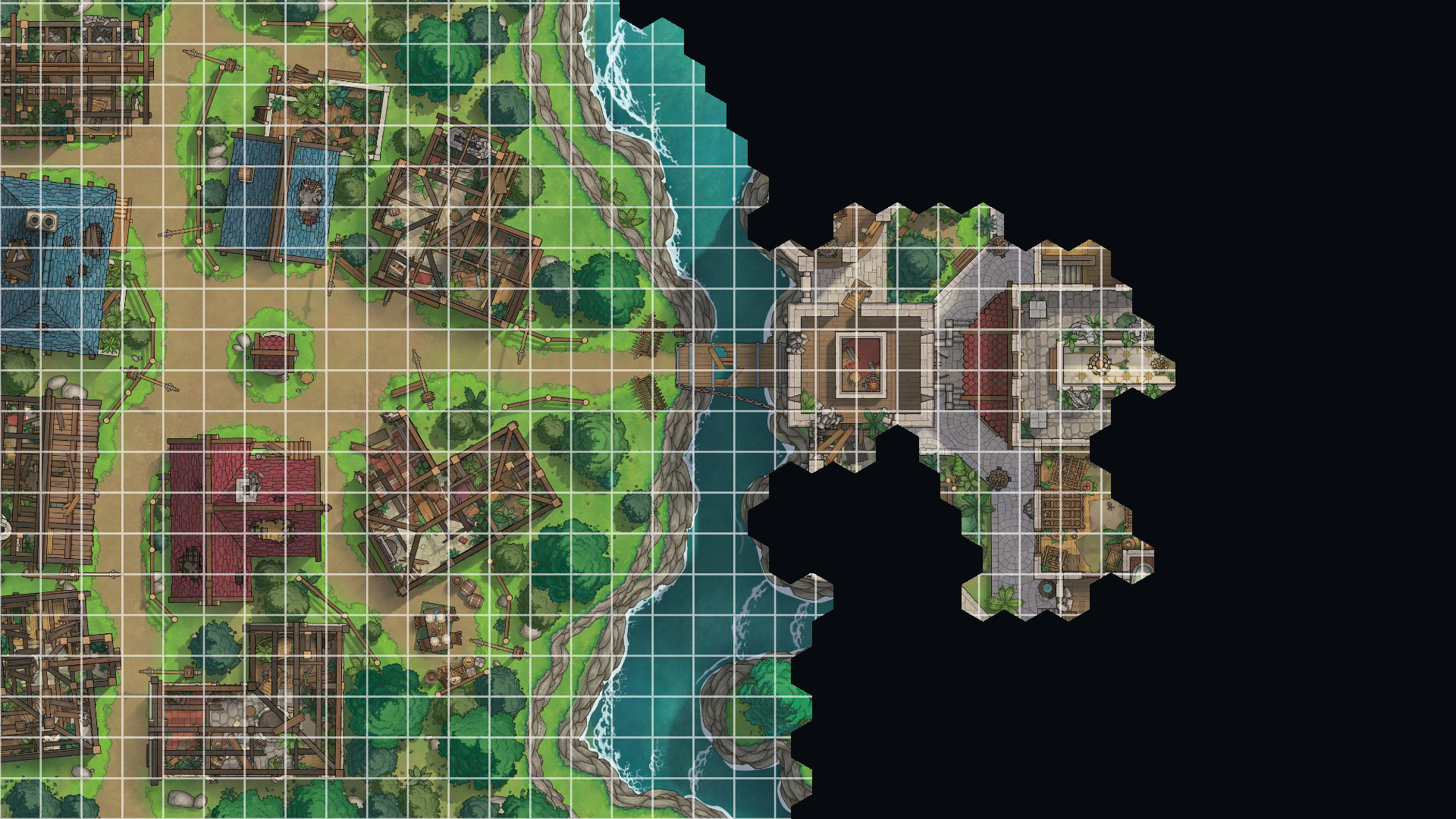
The GM controls everything from their phone, including switching maps, drawing fog of war live as the party explores, adjusting the grid, and managing audio. Maps are organised into collections, so a GM can group everything for a campaign or a session and switch between them quickly during play, with audio pinned per map. Collections can be exported and imported, which makes it straightforward to back up a library, move it to another device, or share a prepared set with someone else. The display itself shows only the map, with no menus, cursors, or interface clutter visible to players. Everything runs locally over the group's own Wi-Fi, and after initial setup the system never touches the internet, making it suitable for venues without reliable connectivity.

Key features

Static and animated maps up to 4K60
Fog of war drawn on the phone, revealed live on the screen as the party explores
Grid overlay calibrated to your screen (size, shape, colour, opacity)
Maps organised into collections
Audio pinned per map for autoplay on map selection or playable from the playlist
Collections can be exported and imported for backup, transfer, or sharing
Music and ambience over Bluetooth, AirPlay, HDMI, or the Pi's audio jack
Idle screens, colour grading, and animated overlays such as clouds and fog
Controller runs in any browser, optimised for mobile device operation
Fully offline after setup

Suitable for

Groups playing in person who want maps displayed on a TV or table screen without a computer at the table, who prefer to keep their physical minis, and who want a setup that works without configuration or accounts.

Links

tablestage.com https://tablestage.com/ - Official website

Other entries

Basic Roleplaying (2023)
Tabletop Roleplaying Games

Basic Roleplaying (2023)

TTRPG
Rules-light
Chaosium
Basic Roleplaying is the venerable "D100" engine that has powered Chaosium’s greatest hits for over four decades. Originally appearing as a slim booklet in 1980, it was most recently revitalized as the Basic Roleplaying: Universal Game Engine in 2023. In 2026, it stands as one of the industry's most important open-source platforms, released under the ORC License, allowing independent creators to build and sell their own games using its legendary, time-tested mechanics. Description BRP is a "genre-neutral" toolkit that discards character levels and rigid classes in favor of a pure skill-based system. Whether you are playing a Bronze Age warrior, a 1920s detective, or a futuristic mech pilot, the core experience remains the same: your character is defined by what they can do. Because it uses percentages (e.g., "I have a 65% chance to climb this wall"), it is widely considered the most intuitive and "transparent" RPG system for new players to understand at a glance. System Overview & Key Features The Universal D100 Engine Every action is resolved by rolling two ten-sided (d10) dice to get a result from 1 to 100. If you roll is equal to or under your skill rating, the action is deemed a success. This approach simplifies the mechanical process of the game, as there are no complex tables to keep track of and compare to decypher whether it is a success or failure. Organic Character Growth There is no "Experience Points" system in the traditional sense. Instead, when you succeed in using a skill, you mark a "Skill Check" on your character sheet. At certain stops in the game/story, the player rolls to see if the character improves in those skills, meaning your character evolves based specifically on the actions they performed (and succeeded at) during the game. Modular Rule Design The Universal Game Engine is designed with variations and systems to choose from. GMs can choose whether they prefer to just use "Hit Points" or add a more detailed wound system with "Hit Locations" for more realistic tactical consequences. Systems for Magic, Sorcery, Mutations, or Superpowers (depending on the setting) can be added, instead of being baked in the core mechanics, ensuring the mechanics always fit the theme of the game. Deadly and Tactical Combat BRP combat is grounded and dangerous. Unlike high-fantasy games where adventurers have a vast health pool, a single strike of a sword or bullet in BRP can be fatal. This encourages players to think creatively and use mechanics and terrain to their advantage. Talking their way out of situations is often seen as more reasonable (and survivable), than just treating every conflict as a forced combat situation. The ORC License Revolution By introducing to the Open RPG Creative (ORC) license, BRP started a wave of third-party "Powered by BRP". This has expanded the system into new genres like Cyberpunk, Wuxia, and Cozy Fantasy, all supported by a single, unified ruleset and system, compatible with most themes. Compatibility with "The Big Three" Because the core mechanics have remained the same since the beginning, a monster or spell from a 1980s supplement is almost always compatible with the modern 2026 engine. This gives GMs access to one of the largest libraries of pre-written adventures in tabletop gaming, spanning Call of Cthulhu, RuneQuest, and Pendragon. Additional links chaosium.com/brp : Official BRP Universal Game Engine portal basicroleplaying.org : The primary community hub and "BRP Central" forums

Read more

Dungeon Master Diaries
Actual Play & Podcasts

Dungeon Master Diaries

TTRPG
Discussions
Shadowdark RPG
Dungeon Master Diaries is a podcast about Shadowdark and other role-playing games where two GMs talk about their recent experiences at the table, and hopefully give you something useful that you can take to yours. Links dungeonmasterdiaries.libsyn.com - Podcast website youtube.com - Youtube channel spotify.com - Spotify feed discord.gg - Discord server

Read more

Memory of Ord
Tools & Platforms

Memory of Ord

English
Free
Campaign Management
Memory of Ord is a free community tool for Draw Steel. Its systems, monsters, and gameplay loops are baked into the tool's terminology, defaults, and features. Your story structure, visualized Scenes, combats, montages. Every beat and detail as a node. Each carries the details that matter to your table: default options drawn from the Draw Steel core books, fully extensible, and visually customizable. From tonight's session to the full campaign Every node can be a container for deeper content nested inside it. Compose quests from individual scenes, combine those into adventures, and layer them together in a full campaign. Work top-down for structure or bottom-up from inspiration. Zoom into the details for your next session; zoom out to see the threads coming together and identify connective gaps. Remix, borrow, and share This game is social and fun, and designing for it should be too! Pull in community content to fill gaps, mold it as needed, and share your own work when it's ready. Links memoryoford.com - Official website

Read more

Reviews

Sorted by:

No reviews yet.

Login to leave a review.

Looking for a group?

Find a tabletop group to join or players to invite.
Groupfinder is a free looking-for-group/players platform. By players, for players.